
2nd Public Private Forum on Beyond SDGs: Forum Event Confirmed!
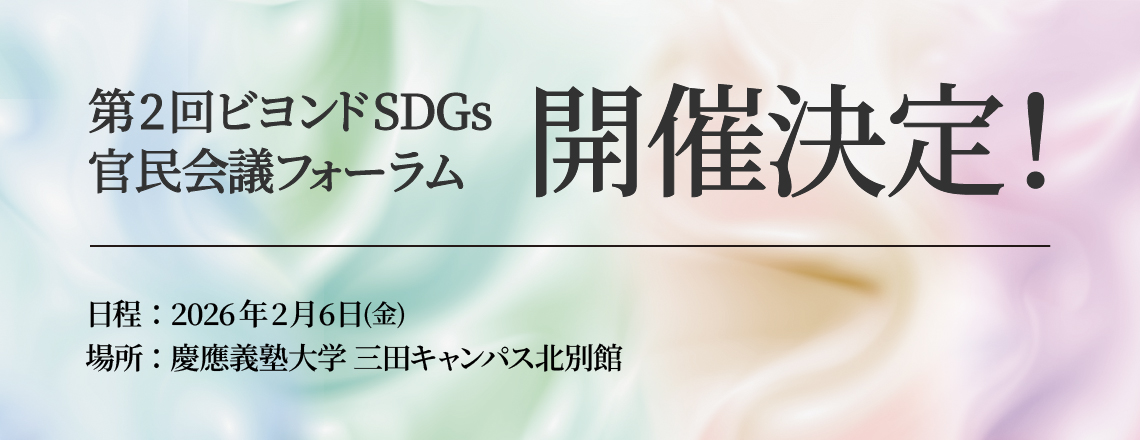
Public Forum in the morning; Working Groups launch full-scale in the afternoon!
The Public Private Forum on Beyond SDGs (President: Norichika Kanie, Professor, Graduate School of Media and Governance, Keio University) will host the 2nd Public Private Forum on Beyond SDGs Forum on Friday, February 6, 2026.
The morning session of this forum will serve as a public forum to consider international goals beyond 2030 (Beyond SDGs), featuring inputs and discussions by experts centered around academia. In the afternoon, Working Group sessions based on the “Six Entry Points” presented in the UN GSDR will start, launching concrete discussions in earnest under the leadership of co-chairs.
We welcome the participation of a wide range of individuals interested in the vision for society beyond 2030.
Please note that applications for participation in the Working Groups will open on this website starting January 5, 2026.
Event Overview
・Date & Time: Friday, February 6, 2026, 9:30 AM–5:00 PM (tentative)
・Venue: Keio University Mita Campus, North Annex (1-4-65 Mita, Minato-ku, Tokyo)
https://www.kgri.keio.ac.jp/docs/access_kitabekkan.pdf
・Organizer: Board of Directors, Public Private Forum on Beyond SDGs
・Co-organizers: Keio University Global Research Institute (KGRI) Keio STAR
Sustainable Development Solutions Networks (SDSN) JAPAN
・Registration: https://forms.gle/qC1kgPn1WacedwVCA
Program
■ 2nd Public Private Forum on Beyond SDGs Plenary (9:30 AM–12:00 PM)
Inviting experts from academia to share perspectives on sustainability, societal models, and international goals beyond 2030.
・Opening Remarks by Organizer
・”On the Development of the Public Private Forum”
Norichika Kanie (Professor, Graduate School of Media and Governance, Keio University / Chairperson, Public Private Forum on Beyond SDGs)
・Input Talk: “Beyond SDGs – Perspectives for Considering Goals and Targets”
Hiroaki Miyata (Professor, Department of Health Policy and Management, School of Medicine, Keio University)
Kiyoshi Takahashi (Head, Social Systems Division, National Institute for Environmental Studies)
Yoko Takimoto (Project Assistant Professor, Graduate School of Media and Governance, Keio University)
Yuto Kitamura (Professor, Graduate School of Education, The University of Tokyo)
Yuriko Oda (Representative Director, Certified NPO WheeLog)
・Q&A and Free Discussion
Moderator: Ayako Sakurada (Eco-announcer)
■ Working Group Sessions (1:00 PM–5:00 PM)
Discussions on concrete goals, targets, indicators, governance approaches, etc., in working groups based on the Six Entry Points.
・Opening Remarks by Secretary General
・Explanation of Purpose for Working Groups
・Topic Presentations by Working Group Co-Chairs
・Kick-Off Discussions Divided into 6 Working Groups
・Working Group Reports to the Plenary Session & Summary: Working group co-chairs present reports on the day’s discussions, followed by Chairperson Norichika Kanie’s summary outlining future developments and expectations.
In the afternoon sessions, discussions targeting Beyond SDGs will take place, and the direction for working group activities spanning 2026 to 2027 will be shared.
【What are the Six Entry Points?】
The “Six Entry Points” for transformation toward a sustainable future proposed in the Global Sustainable Development Report (GSDR) 2019 and 2023 published by the United Nations. The Public Private Forum uses them as the starting point of its discussion framework to advance discussions on future goals without being constrained by existing frameworks, while considering the interconnections among issues.
1. Human well-being and capabilities
2. Sustainable and just economies
3. Sustainable food systems and nutrition patterns
4. Decarbonizing energy systems and universal energy access
5. Sustainable urban and peri-urban development
6. Global environmental commons
Forum Speakers
・Hiroaki Miyata (Professor, Keio University)
Completed Master’s Program in Health Sciences and Nursing, Graduate School of Medicine, The University of Tokyo, in 2003. Doctor of Health Sciences (Ph.D. by dissertation) in the same field.
After serving as Assistant at Waseda University Faculty of Human Sciences and Assistant Professor at the Department of Healthcare Quality Assessment, Graduate School of Medicine, The University of Tokyo, he became Associate Professor at the same department in April 2009, Professor in April 2014 (part-time since May 2015), Professor at the Department of Health Policy and Management, School of Medicine, Keio University in May 2015, and Visiting Professor at the School of Medicine, Osaka University in December 2020.
He serves as Thematic Project Producer for Expo 2025 Osaka, Kansai; Advisor for Umekita Phase 2; Advisory Board Member for the Data Health Reform Promotion Headquarters of the Ministry of Health, Labour and Welfare; Health Information Director for Niigata Prefecture; Value Co-Creation Officer for Kanagawa Prefecture; and Board Member of the International House of Japan, among other roles. His specialties include data science, scientific methodology, and Value Co-Creation. Utilizing science such as data science to challenge social transformation, his research activities center on contributing to making reality better. In collaboration with the specialist medical system, he engages in various practical initiatives extending beyond medical fields, including the National Clinical Database involving 5,000 hospitals, and the national COVID-19 survey conducted jointly by LINE and the Ministry of Health, Labour and Welfare. At the same time, he collaborates with various stakeholders—not only academia, but also government, economic organizations, NPOs, and companies—to envision new social visions. One of the social visions Miyata co-creates is a “Resonating Society,” where a diverse society is created by resonating lives together, and each individual shines while experiencing that world together.
・Kiyoshi Takahashi (Head, Social Systems Division, National Institute for Environmental Studies)
Head of the Social Systems Division, National Institute for Environmental Studies. Ph.D. in Engineering. Involved in the development and application of the Asia-Pacific Integrated Model (AIM) used for climate policy analysis, specializing in global climate impact projections. In recent years, he has also been working on evaluating the impacts of climate change and climate policies on sustainability. Served as Lead Author for the IPCC Fourth and Fifth Assessment Reports.
・Yoko Takimoto (Project Assistant Professor, Graduate School of Media and Governance, Keio University)
Graduated from Tokyo Woman’s Christian University Department of Sociology, completed Master’s program at Harvard Graduate School of Education, and completed Doctoral program at Gakushuin University Graduate School of Humanities. Ph.D. in Education. After working as a development consultant, environmental consultant, renewable energy business developer, and specialist researcher at Tokyo Gakugei University, she assumed her current position. Specialized in sustainable development, teacher education development, environmental and energy policy, and analysis of synergies and trade-offs among SDGs. Currently engaged in research on strengthening synergies and resolving trade-offs to accelerate transformation toward achieving the SDGs (supported by Environment Research and Technology Development Fund).
・Yuto Kitamura (Professor, Graduate School of Education, The University of Tokyo)
Graduated from Keio University Faculty of Letters, Department of Human Relations (Education major). Completed Master’s and Doctoral programs in Social Sciences and Comparative Education, Graduate School of Education and Information Studies, University of California, Los Angeles (UCLA). Ph.D. in Education. After serving as Associate Education Specialist at UNESCO Headquarters in Paris (Education Sector), Associate Professor at Nagoya University Graduate School of International Development, Associate Professor at Sophia University Faculty of Human Sciences (Department of Education), and Associate Professor at The University of Tokyo Graduate School of Education, he assumed his current position. He also serves as Special Advisor to the President (International Strategy Planning) and Deputy Director of the International Strategy Office at The University of Tokyo. He has previously held positions including Fulbright Research Scholar at The George Washington University, Visiting Professor at the Japan Center, University of Dhaka (Bangladesh), and Special Advisor to the Rector of the Royal University of Phnom Penh (Cambodia). Currently, he serves as Member of the Tokyo Metropolitan Board of Education, Associate Member of the Science Council of Japan (23rd–26th terms), Member of the Japanese National Commission for UNESCO, Visiting Fellow at the JICA Ogata Sadako Research Institute for Peace and Development, Board Member of the World Educational Research Association (WERA), Executive Board Member of the Japanese Educational Research Association, Board Member of the Japan Comparative Education Society, Executive Board Member of the Japan Society for International Development, Board Member of the Yanai Family Foundation, and Board Member of the Morinaga Angel Foundation, among other roles.
・Yuriko Oda (Representative Director, Certified NPO WheeLog / Representative Director, NPO PADM)
Board Member of the Japan Association for Human-Centered Design Organization. Uses an electric wheelchair due to a progressive muscular disease. Won Grand Prix at the Google Impact Challenge in 2015 and released the barrier-free map app “WheeLog!” in 2017. Expands activities under the mission “Creating a world where people don’t give up, even in a wheelchair.” Aiming to realize Japan as a welfare-advanced nation from the perspective of a former non-disabled person and current person with disability. Recipient of numerous awards, including the Minister’s Award for Promoting Barrier-Free Design (Ministry of Land, Infrastructure, Transport and Tourism), Prime Minister’s Award at the “Japan SDGs Award,” and Expo Live Global Innovator at Dubai Expo. Committee member of the Follow-up Conference on Architectural Design Standards Considering Smooth Mobility for the Elderly and Persons with Disabilities (MLIT), and Member of the Tokyo Metropolitan Welfare Town Building Council. Author of LOVE & SDGs: Creating a world where people don’t give up, even in a wheelchair (Hoshun-in).
Future Schedule
Around June 2026: Interim Report Forum
Around February 2027: Final Report Forum
September 2027: Discussions on international goals beyond 2030 begin in earnest at the UN General Assembly
Click here for the PR TIMES release