
1st Workshop Report: “MOYAMOYA to AGENDA” for U-25
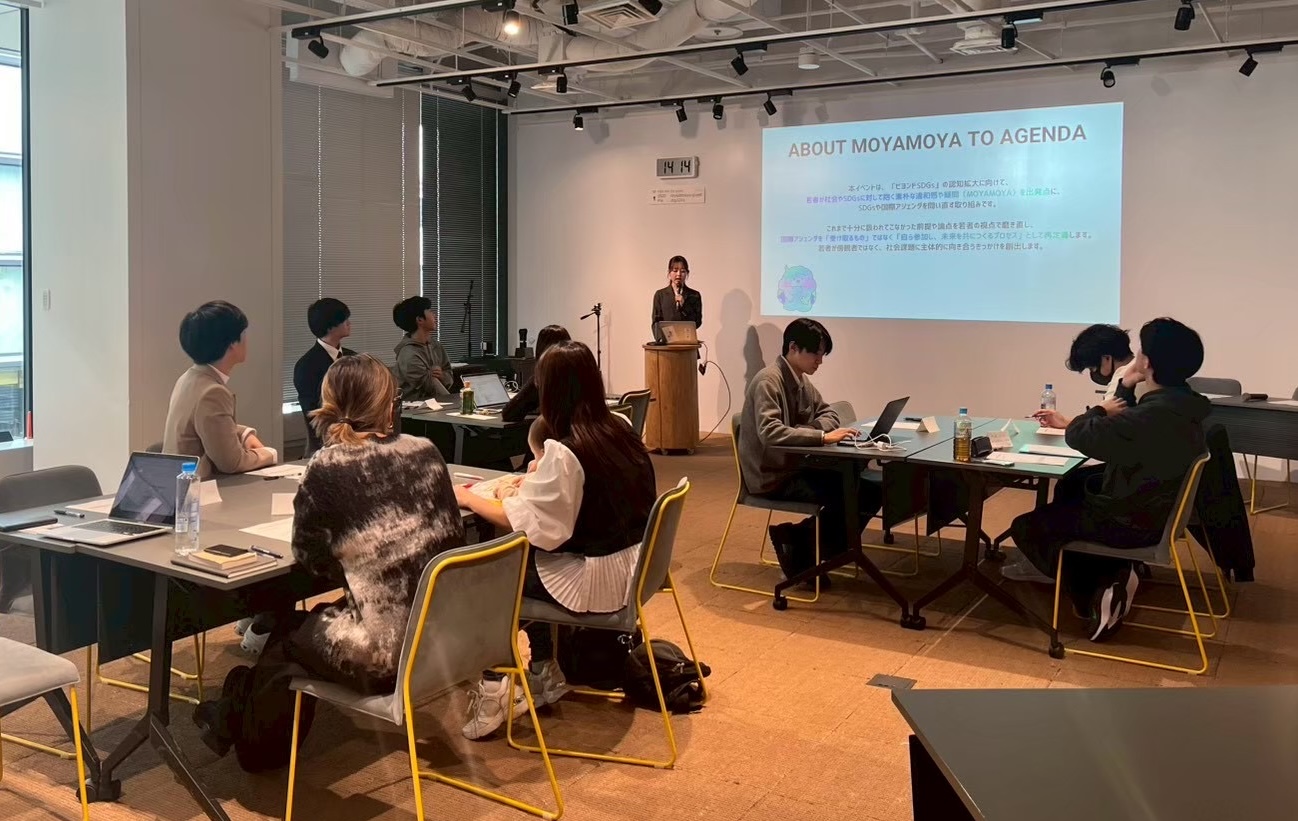
On February 27, 2026, a workshop for U-25 participants titled “MOYAMOYA to AGENDA: Thinking Beyond SDGs from Discomfort,” organized by the Kanie Seminar Beyond SDGs Youth Group (Representative: Eri Kodama, 4th-year student, Faculty of Policy Management, Keio University), was held at City Lab TOKYO.
In this inaugural session, participants included members of university laboratories and student clubs related to sustainability, as well as U-25 working adults active in the same field. In addition, Keio University Professor Norichika Kanie and Hakuhodo Fellow Masahiro Kawatei, who worked on the Japanese translation of the 17 SDG goals, were invited as guests. Taking the feelings of discomfort (= MOYAMOYA) harbored by youth as a starting point, the workshop brought to light questions and challenges that the SDGs have not adequately addressed, developing forward-looking discussions toward Beyond SDGs.
Purpose of the Event
As 2030, the target deadline for achieving the SDGs, approaches, discussions at the United Nations regarding Beyond SDGs are set to begin in 2027. However, how many people today can paint a bright picture of the future? While the SDGs have gained broad recognition and achieved a certain degree of results in Japan, many voices raise doubts about whether initiatives remain superficial. Furthermore, while youth voices have been increasingly valued in recent years, the perception that SDG discussions require extensive knowledge and expertise is considered one of the reasons young people are not being sufficiently involved.
Based on this reality, this event placed emphasis on creating a space where anyone could speak without hesitation, regardless of their level of knowledge or expertise. The keyword of this event, “MOYAMOYA,” refers to vague, inexpressible feelings or points of discomfort held toward daily life and society. We designed a process to visualize such internal MOYAMOYA of each individual, verbalizing and deepening it through dialogue with others to sublimate it into a social agenda. This process dispelled the common tendency of existing sustainability-related events to “easily converge on normative and superficial discussions,” creating an opportunity to generate new questions and a starting point for value creation.
Program of the Day
Workshop
In the first half of the event, taking the MOYAMOYA felt daily by the participants themselves as a starting point, a workshop was conducted to deepen discussions through the following three steps:
1. Writing down MOYAMOYA related to sustainability felt in daily life (individual work)
2. Analyzing MOYAMOYA from angles such as “Why did I feel that way?” and “Who is involved?” (individual work)
3. Sharing respective MOYAMOYA while holding discussions (group work)
Finally, each group presented the results of their discussions from various perspectives.
Group 1: Humanity Lacks Love
In this group, MOYAMOYA such as “SDGs are recognized but not deeply embedded,” “The importance of regional revitalization is known, but few people take action,” and “The goal of corporate sustainability activities has become obtaining certifications” were raised. What was derived from these challenges was the common denominator that “humanity lacks love.” Companies engaging in regional revitalization or community-rooted activities possess gratitude and respect for the land they are connected to, conducting projects based on the belief that their activities there hold meaning; as fans gather around them, their business moves forward constructively. A hypothesis emerged that as we approach Beyond SDGs, if this feeling can be awakened in humanity once again in some form, MOYAMOYA will naturally be resolved.
Group 2: How to Reconceptualize the SDGs
In this group, discussions centered on how to reconceptualize the SDGs, focusing on MOYAMOYA such as “the compatibility of capitalism and sustainability,” “society after achieving the goals,” and “youth anxiety caused by information overload.” With the development of social media, people can access various information, making diverse social issues visible. On the other hand, a reality exists where information overload results in social issues being treated as someone else’s business. In corporate activities, opinions were raised that balancing profit-making activities with sustainability is difficult, leading sustainability promotion to end up as a superficial strategy. Thus, for future agenda items, the group arrived at “creating mechanisms to make social issues a personal matter,” “examining methods to align economic rationality with social significance,” and “organizing concrete methods for sharing philosophies within organizations.”
Group 3: Questioning the Essence and Facing “People”
In this group, MOYAMOYA regarding “balancing sustainability and profit pursuit,” “sustainability of current systems,” and “sustainability of learning methods” were shared, leading to discussions centered on foundational questions that re-examined the core of the SDGs. Although it did not reach a complete clarification of MOYAMOYA, it provided an opportunity to organize feelings of discomfort toward the SDGs and social issues, gaining perspectives to grasp their essence. Through discussions on the relationship between means and ends in the SDGs, organizational structures, and youth voices, the idea emerged that rather than viewing the SDGs merely as goals, facing “people” while questioning the background and essence is the first step in confronting MOYAMOYA and is necessary when considering Beyond SDGs.
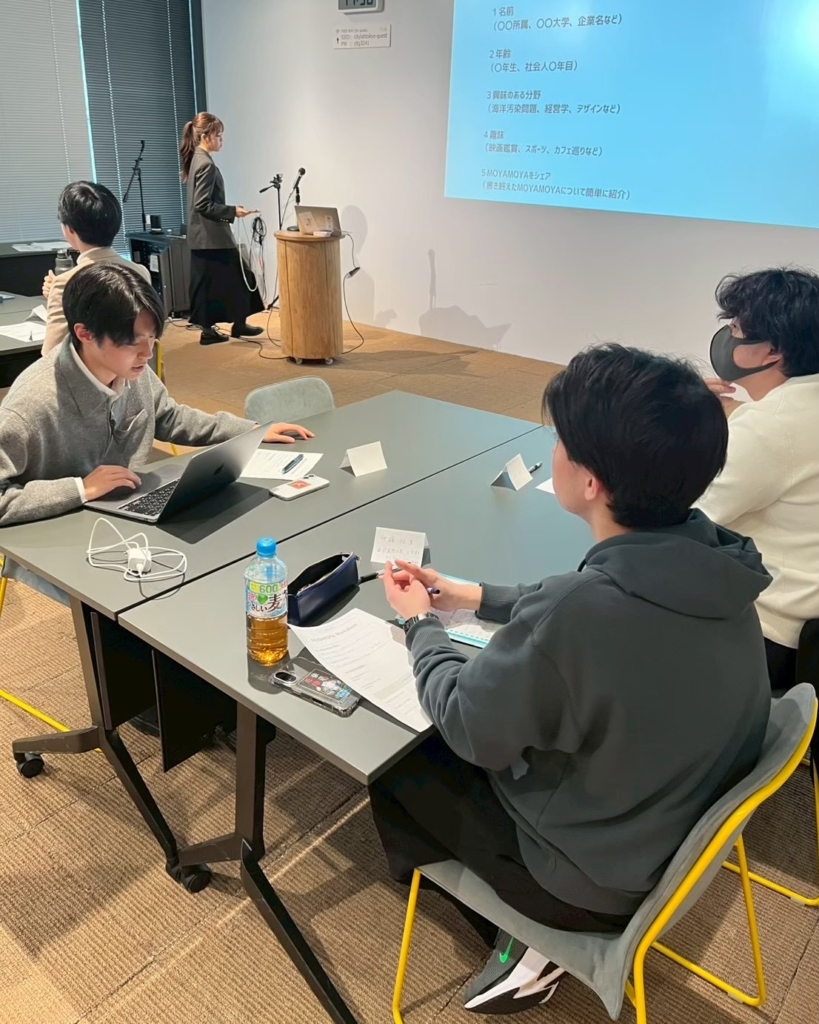
Talk Session
After finishing the plenary sharing of the workshop, in the second half of the event, guest speakers Mr. Kanie and Mr. Kawatei spoke about their thoughts on Beyond SDGs and the actions they seek from the youth generation.
“The Post-2030 Period Is the Main Arena”
Norichika Kanie (Professor, Graduate School of Media and Governance, Keio University)
Having participated in UN discussions since the very beginning of the SDGs, I was already looking ahead to the world beyond 2030 around 2011 when discussions commenced. When the SDGs were adopted, hardly anyone knew about them, but today they have become international visions known to most people. I am convinced that the next international visions beyond the SDGs can undoubtedly be made into ‘our own goals.’ Just like in this event, I hope that the number of people saying ‘I want to do this’ will increase, with actions taking place one after another in various places, spreading like a movement.
Amid growing fragmentation in various parts of the world today, what becomes important is ‘valuing relationships.’ In today’s discussion as well, talks about ‘love’ came up; this essentially signifies the importance of proceeding while engaging in thoughtful communication. Beyond SDGs also means ‘Beyond Borders,’ but one factor obstructing this is today’s compartmentalized, siloed society. We need to gradually encourage shifts in attitude transcending respective positions. On the other hand, if too much time is spent on that process, the issue arises that what needs to be done cannot be fully completed. We must consider how to balance thoughtful communication with momentum moving forward.
Rather than hesitating and asking ‘Can we really do this?’, I want young people to throw their feelings of ‘I want to do this’ at adults and make full use of working professionals. If young people say ‘I am going to do this’ and press forward in their respective fields across the country, society will begin to move.
Facing Each and Every Individual in Beyond
Masahiro Kawatei (Project Professor, Keio University)
In Beyond SDGs, jibungoto-ka (making it a personal matter) is key. When creating the SDG icons back then, the purpose was not to raise overly complex international issues, but to help people realize that awareness of issues can be gained from each person’s daily life. However, broadening the doorway in that manner is the flip side of remaining uninformed about details. Because achieving both simultaneously is difficult, we first thought about broadening the doorway. As a result, for better or worse, the SDGs spread like a movement.
What becomes important next is how to make the SDGs—which spread through that movement—a personal matter and connect them to substantive action. For that, we need the awareness of issues, solutions, ideas, and insights generated through past activities. Furthermore, as came up in today’s discussion, by engaging in human-centered discussions and facing the MOYAMOYA of the people (individuals) who constitute organizations and society, the direction we should take will become visible.
The message I want to convey to the youth generation is: “Take responsibility for what you have noticed, and value the ‘frontier spirit’ of acting yourself first.” For those who are struggling and feeling MOYAMOYA, I want them to put it into words, even without an answer. The media and entertainment industries are also showing interest in Beyond SDGs. I hope the youth generation will involve adults who will become allies, climbing the stairs together step by step. Taking charge of the various things born from that is the role of the Public Private Forum on Beyond SDGs. Words originating from citizens of the country with the highest SDG awareness in the world will be embedded as messages for international visions beyond 2030. From now on, precisely because you are different from others, you need to put it into words. And we want to create the platform to receive those words.
Thoughts of the Organizers
Through this event, focusing on the internal feeling of MOYAMOYA—a sensation containing complex elements—deepened the understanding of underlying challenges and thoughts, organizing the thinking of each participant.
In the field of psychology, a subtle, bodily felt sensation that is not yet in words is called “felt sense.” The process of turning attention to that sensation and expressing it in words is called “focusing.” While focusing originated in the context of psychotherapy, today it transcends that framework and is widely used as a practical tool for self-understanding and problem-solving. The process conducted in this event—writing down, analyzing, and discussing MOYAMOYA—can truly be called focusing. The value emphasized during the event—that it is okay to be wrong or theoretical, as long as it is voiced—is believed to have deepened participants’ self-understanding.
In the talk session, Mr. Kawatei stated, “For whatever is troubling you, I want you to voice it, even if you don’t have an answer.” To realize the SDG philosophy of “leaving no one behind,” we believe that each individual expressing their MOYAMOYA in words will lead to better Beyond SDGs discussions. Youth who go through this process develop the power of questioning. Raising questions verbalized among youth to the Public Private Forum allows for proposals rooted more in citizens’ perspectives at the UN discussion table in 2027. Reflecting these in the global agenda will lead to better goals that are easy for youth to understand and accept. The significance of youth in this process lies not merely in providing new perspectives, but in functioning as “active agents who continue to pose questions,” visualizing discomfort and contradictions overlooked in existing frameworks. That is precisely why we insisted on sublimating MOYAMOYA into questions through this event.
Based on the above, we believe that “meaningful personalization” (jibungoto-ka) is necessary for Beyond SDGs. While the SDGs achieved high recognition by broadening the doorway, for better or worse they spread like a movement. As a result, the challenge remained that it was difficult to understand specific content or feel its relevance to daily life. Overcoming this challenge requires each individual to have a sense of ownership. That is precisely the reason we held this event. Through the process of sublimating MOYAMOYA into questions described above, providing a “space and mechanism” where anyone can convert their feelings of discomfort into a shared social agenda and participate bottom-up in formulating international visions beyond 2030 is the value we wish to continue providing. And we believe this will serve as a firm step toward creating better Beyond SDGs discussions.