
[3rd Public Private Forum on Beyond SDGs Forum] Working Group Summary | Working Group 1: “Human well-being and capabilities”
Introduction
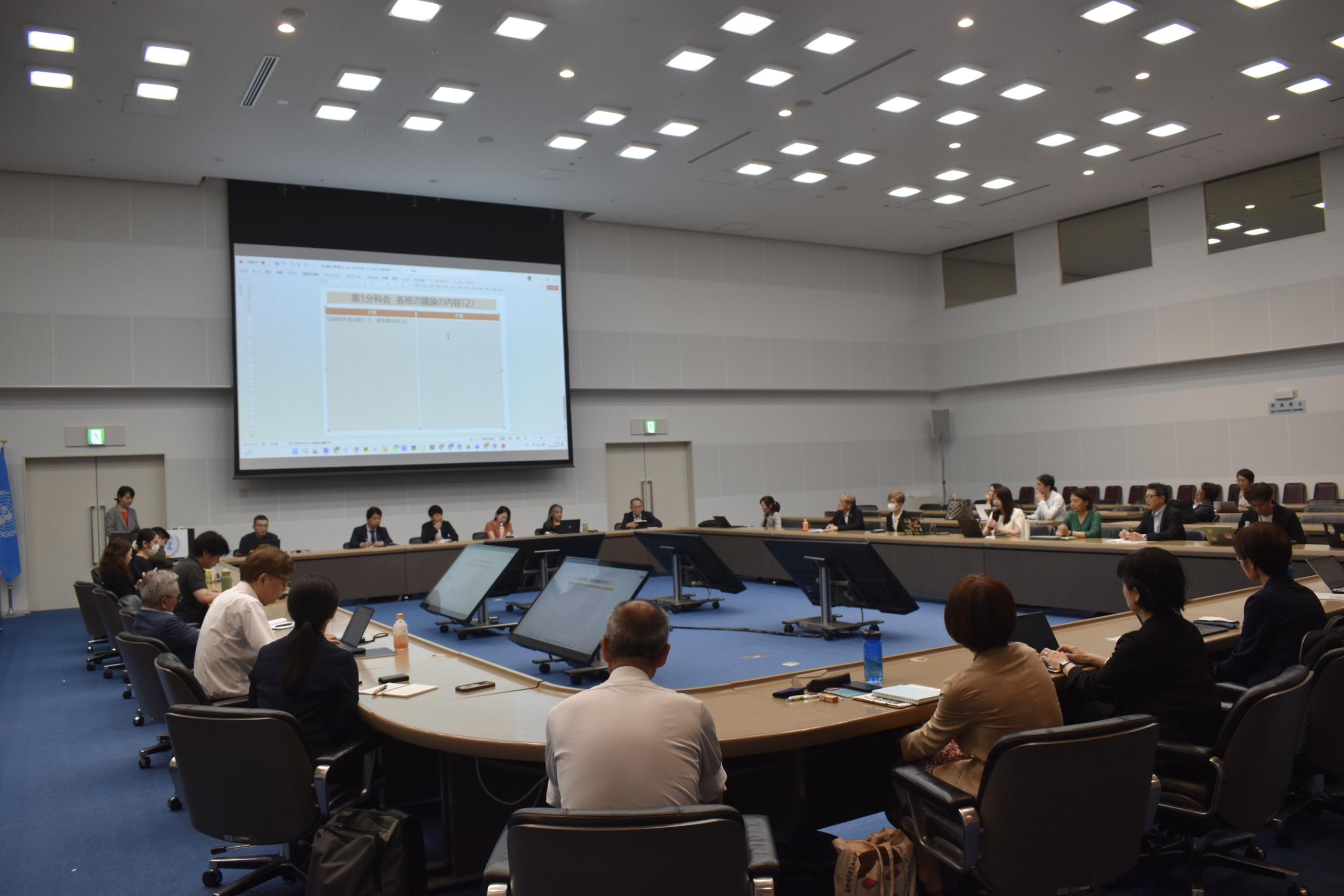
In Working Group 1, we conduct examinations regarding Beyond SDGs under the theme of “Human well-being and capabilities.” Heading into the 3rd Forum, we conducted interviews with experts involved in the formulation and negotiation of the SDGs, as well as a survey targeting diverse stakeholders. In the interviews, we gathered views on the background of the SDGs’ establishment, the significance of multilateralism, challenges in post-SDGs, and related topics. In the survey, we collected opinions from stakeholders active in fields such as persons with disabilities, children and youth, senior citizens, LGBTQ+, gender, poverty, humanitarian aid, peace and disarmament, healthcare, and regional revitalization. Building upon these outcomes, active discussions were held during the 3rd Forum regarding the achievements and limitations of the SDGs, principles to carry forward beyond 2030, new values and challenges to incorporate, and means of implementation and governance. Because Working Group 1 had a large number of participants, four subgroups were established for discussions to ensure sufficient opportunities for participation, expression of opinions, and debate. This report synthesizes those discussions, organized from four perspectives: (1) Perception of current challenges, (2) Direction of desired society, (3) Target frameworks, and (4) Means of implementation and governance.
1.Perception of Current Challenges
(1)The SDGs succeeded in expanding recognition, but have not reached essential understanding
Common across the survey and discussions in all subgroups was the recognition that while the SDGs have spread widely throughout society, challenges remain in their understanding and practice.
Through their introduction into school education and adoption by corporations, the SDGs achieved high recognition in Japanese society. Particularly for the younger generation, they are becoming established as a basic framework when considering social challenges. Furthermore, their role as a catalyst for heightening interest in sustainability and social issues among corporations and local governments was evaluated as a major achievement.
On the other hand, many participants pointed out that the SDGs remain limited to the spread of icons and slogans, without leading to societal transformation or shifts in values. In the survey, terms such as “symbolization,” “eventization,” and “SDG washing” were used, with criticism that for corporations, linking their own businesses to the SDGs has itself become an end.
(2)The status of human rights and peace is regressing
Compared to when the SDGs were adopted in 2015, the world has changed dramatically.
In the survey, major changes pointed out included the expansion of national self-interest, the retreat of multilateralism, the rise of exclusionism, and an increase in armed conflicts. The environment surrounding peace and the rule of law has particularly deteriorated, with shared recognition that SDG Goal 16 (“Peace, justice and strong institutions”) is insufficiently realized. A sense of crisis was expressed over prolonged conflicts—including those in Ukraine and Gaza—rising military expenditures, and the weakening of international law and international humanitarian law. Additionally, challenges raised included backsliding on gender equality and Diversity, Equity, and Inclusion (DEI), regressing human rights awareness, and backlash against establishing human rights for minorities.
(3)Well-being and human capabilities are not adequately addressed
While the SDGs made significant contributions to resolving issues such as poverty, education, and the environment, an awareness of the problem was shared that aspects such as human happiness and the fulfillment of human capabilities have not been adequately addressed. Values such as happiness, sense of purpose in life (ikigai), creativity, cultural richness, and human connection are difficult to capture with existing indicators. Furthermore, issues such as isolation, social hardship (ikizurasa), and mental distress are intensifying in Japanese society, bringing to light challenges that cannot be explained solely by economic growth or material wealth. On the other hand, definitions for the term “well-being” itself are not necessarily shared, and opinions noted the need to clearly organize its social positioning.
(4)Response to the introduction of Artificial Intelligence (AI) is required
In expert interviews and subgroup discussions, changes brought about by AI and digital technology were raised as crucial discussion points. While generative AI and social media hold immense potential, they also carry risks such as the spread of misinformation, impacts on democracy, erosion of humanity, and military application. Shared recognition emerged that international visions beyond 2030 must address these challenges that were not sufficiently anticipated when formulating the SDGs in 2015.
2.Direction of Desired Society
(1)A society grounded in human rights and peace
Most strongly shared throughout the working group was the thinking that human rights and peace should be set as the foundation for all goals.
The principle of “leaving no one behind” was evaluated as one of the greatest achievements of the SDGs. Endorsement gathered for the stance that moving forward, society must aim to guarantee the dignity and rights of all people, including persons with disabilities, children, women, sexual minorities, senior citizens, and low-income populations.
Furthermore, numerous opinions emphasized positioning peace as a prerequisite for health, welfare, and the fulfillment of capabilities.
(2)A society centered on well-being
Well-being became one of the most vital keywords throughout these discussions. However, it is grasped not merely as subjective happiness, but as a comprehensive value encompassing human security, social participation, cultural activities, human connection, and hope for the future. Consensus was also reached on expanding the perspective beyond individuals to the well-being of society as a whole.
(3)A society centered on children and future generations
In connection with the theme of capability fulfillment, numerous opinions advocated centering children and youth. The concept was proposed that guaranteeing opportunities for learning, play, culture, nature experiences, and social participation for all children—without depending on family background or income status—is vital. Furthermore, the idea was shared that capability fulfillment should not be attributed to individual effort or self-responsibility, but that society should establish the conditions for it.
(4)A society achieving harmony with nature
The concept of “planetary well-being,” transcending anthropocentrism, was also raised. Rather than viewing humans in isolation from nature, society should stand on the recognition that humans are part of living systems, aiming for a society that achieves harmony with biodiversity and the global environment.
3.Target Frameworks
(1)Inheriting and developing the SDGs
In the preliminary survey regarding post-SDGs, 70% of respondents believed that “it would be better to formulate new goals by reviewing them to fit the era while referencing the SDGs,” while 30% felt that “the SDGs should be extended while making minor modifications such as adding necessary new issues or deleting unnecessary ones as of 2030.” However, in subgroup discussions, the majority opinion favored developing upon the existing SDGs as a foundation rather than completely remaking the goals. The 2030 Agenda and the 17 Goals represent crucial assets formed through years of international negotiations; shared thinking emphasized leveraging their recognition and societal accumulation, as well as avoiding the risk of losing international consensus.
(2)Placing core principles at the center once again
Numerous opinions indicated that moving forward, rather than focusing solely on goals and targets themselves, there is a need to more clearly emphasize human rights, “leaving no one behind,” the “5 Ps”*1, integration, and interlinkages.
*1 “5 Ps”: A concept defined in “Transforming our world: the 2030 Agenda for Sustainable Development,” comprising People, Planet, Prosperity, Peace, and Partnership.
(3)Incorporating new challenges
Opinions highlighted that post-SDGs must address challenges that were not sufficiently recognized in 2015, such as AI, information space, resilience, arts and culture, responsibility to future generations, and social inclusion and connection.
(4)The perspective of “Beyond GDP”
The necessity was raised to adopt “Beyond GDP” perspectives rather than focusing solely on economic growth, introducing new indicator frameworks to evaluate subjective happiness, social connections, disparities, environmental footprints, and social capital.
4.Means of Implementation and Governance
(1)Adaptive governance
The existence of challenges that could not be fully anticipated in 2015—such as the COVID-19 pandemic and the rapid advancement of AI—demonstrates the limitations of fixed 15-year plans. A shared recognition emerged for adaptive governance that sets long-term visions toward around 2045 while flexibly reviewing goals and approaches through reviews every three to five years.
(2)Multi-stakeholder governance
In interviews, the significance of SDG negotiations being shaped while involving civil society alongside nation-states was highlighted. A shared recognition emerged that moving forward, multi-layered governance mechanisms will be crucial—where diverse social sectors such as civil society (NGOs/NPOs), corporations, local governments, educational institutions, cooperatives, and labor unions participate as equal active agents alongside national governments and the United Nations.
(3)Toward a society supporting education and capability fulfillment
Education remains a vital means of implementation, but rather than mere knowledge acquisition, it requires fostering the capacity to understand human rights, peace, culture, and connections with nature, taking proactive action. Furthermore, shared thinking emphasized placing at the center of governance the societal establishment of environments where each individual can fulfill their capabilities, while avoiding the transfer of responsibility onto individuals.
Summary
Through discussions and investigations up to and including the 3rd Forum, Working Group 1 outlined the direction for post-SDGs: “Grounded in human rights and peace, realizing well-being not only for individuals but for society as a whole, aiming for a society where all people can fulfill their capabilities.” Furthermore, to achieve this, a shared recognition emerged that rather than simply switching the SDGs to a new goal system in 2030, we must inherit the principles and achievements of the SDGs while placing human rights, peace, and well-being at the core. Integrally capturing human happiness, social inclusion, connections with culture, communities, and nature, as well as responses to an era where AI plays a significant role, under multi-stakeholder collaboration and adaptive governance, society is required to transition beyond the stage of “awareness and dissemination” to the stage of practicing societal transformation toward realizing a “sustainable society.”