
2nd Public Private Forum on Beyond SDGs: Forum Report 【Reports from 6 Working Groups】
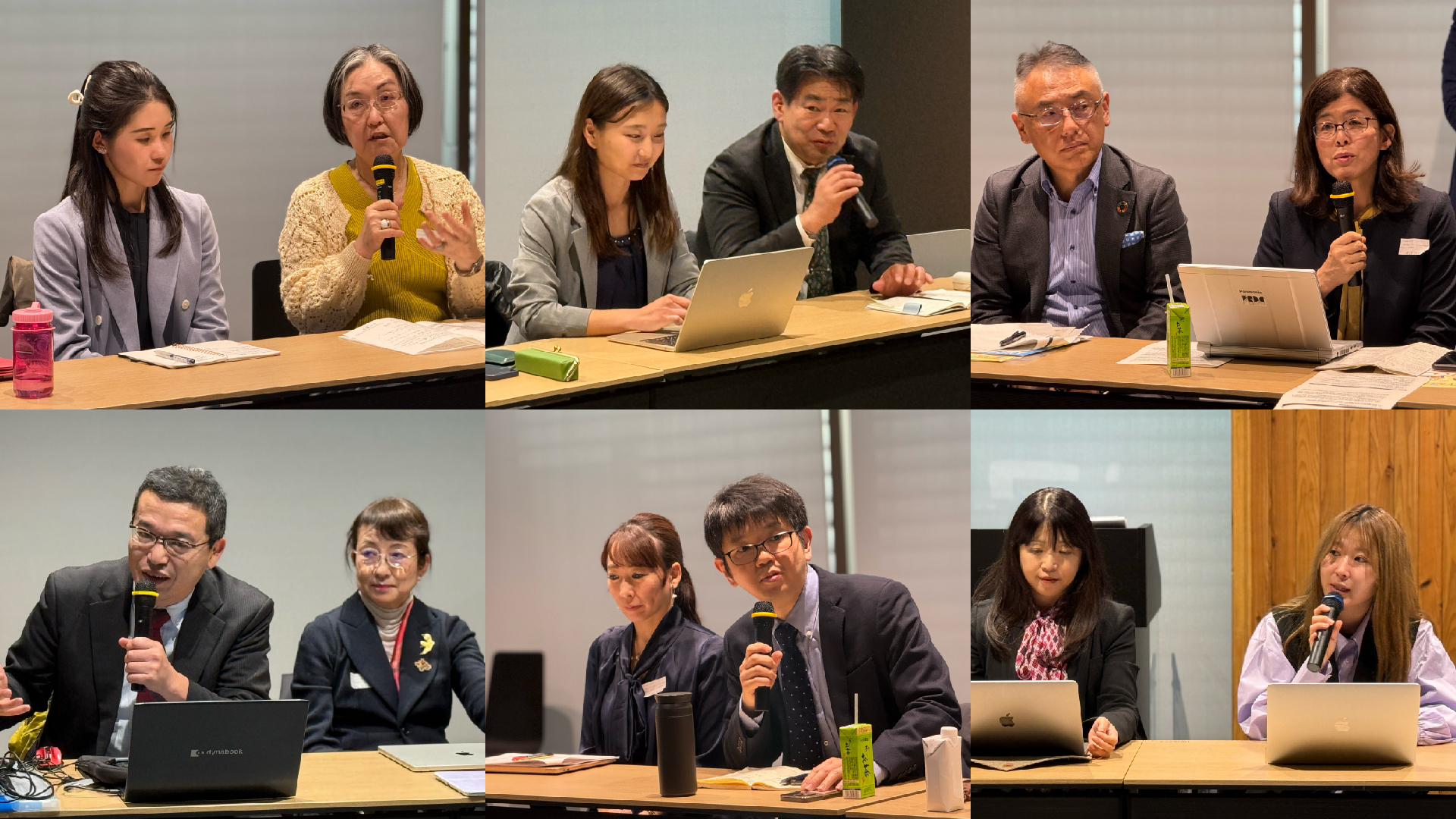
In the afternoon, participants separated into individual meeting rooms, where concrete discussions took place across six theme-based Working Groups. The themes correspond to the “Six Entry Points” presented in the United Nations’ Global Sustainable Development Report (GSDR). Under their respective themes, each Working Group shared challenges and exchanged views on the future direction of discussions. At the end of the meeting, co-chairs provided reflections, and discussions are scheduled to continue within each Working Group moving forward.
Working Group 1
Human well-being and capabilities
Co-Chairs
Masaki Inaba (Representative, Global Health Civil Society Network)
Atsuko Miwa (Co-chair, Japan Civil Society Network on SDGs)
This Working Group focuses on the theme “Human well-being and capabilities.” Because the scope is extremely broad, it is a Working Group that possesses both the flexibility and the challenge of “being able to talk about virtually anything.” This time, we centered our approach on hearing opinions from all participants, resulting in a dense and highly fulfilling exchange of views while each person adhered to their allotted time.
During the discussions, multiple people emphasized the question of how to overcome “SDG fatigue.” Furthermore, a key discussion point emerged regarding whether relying solely on past “problem-solving” approaches is truly sufficient. After a 30-year journey spanning from the MDGs to the SDGs, it is an undeniable fact that a certain sense of fatigue has accumulated on the ground. Simply extending existing frameworks fails to inspire enthusiasm for taking the next step—hearing such candid feedback, we must now blow fresh air into the discussion.
These earnest questions are closely tied to discussions on well-being and capabilities. We intend to earnestly examine the diverse opinions gathered from over 30 participants in this session and further deepen our discussions heading into the interim report in June.
Working Group 2
Sustainable and just economies
Co-Chairs
Mariko Kawaguchi (Board member, Global Compact Network Japan / Spcially Appointed Professor, Rikkyo University)
Erina Kondo (Member, G7/G20 youth Japan)
This session focused primarily on listening broadly to participants’ opinions. Although the discussion has not yet converged, many questions worth pursuing continuously in the future were raised.
In this Working Group, discussion began with the fundamental question: “What is a just economy?” Facing the distortions of current capitalism head-on, a major focus was how to incorporate non-monetary values—which have historically been invisible alongside monetary values—into social systems and leverage them. Multi-layered discussion points were exchanged, including balancing self-interest and altruism, designing symbiotic communities, verbalizing social capital and connecting it to sustainability, as well as inclusivity and profit circulation. In particular, attention was drawn to the distinction between what is indicator-quantified and what is not, discussing how the latter should be revalued as a “force that shapes society.” What indicators should we possess, and is indicator setting itself the goal in the first place? Participants shared a deep common understanding of the importance of first verbalizing “what kind of society we want to build” without confusing means with ends.
In addition, a structural shift was proposed toward having youth lead while seniors support as advisors. While acknowledging the reality that corporate front lines struggle with non-financial metrics, discussions questioning the essence of the economy were also memorable. For instance, just as “whether a carpenter lives next door” carries decisive meaning in disaster-affected areas, trust and relationships themselves serve as crucial economic resources. Re-evaluating such “trust-based economic actions independent of money” through a modern lens, proposals were made to examine institutional designs offering choices outside market economies, as well as entirely new economic models combining physical living spaces and cyberspace.
Furthermore, from a Beyond perspective unconstrained by existing economic boundaries, the necessity of an international solidarity tax to address wealth concentration and tax avoidance by global corporations was discussed, alongside points noting that current economic distortions hinder innovation. However, when newly constructing relational capital, design is required so as not to carry over negative elements embedded in existing regional relational capital, such as gender inequality. With participants from diverse backgrounds, this session offered numerous valuable problem statements that build great expectations for the next meeting.
Working Group 3
Sustainable food systems and nutrition patterns
Co-Chairs
Masahiro Higa (Senior Managing Director, Japan Joint Committee of Cooperatives [JJC])
Yasuko Kono (Board member, Japan Consumer’s Association)
※On the day of this forum, the following two individuals attended as proxies for the co-chairs:
Chikatsugu Fujita (General Manager, IYC Project Team, Japan Joint Committee of Cooperatives)
Maki Morita (Consumer Life Consultant / Representative Director, Food Communication Compass)
In this Working Group, together with 13 participants, we delved deep into the most relatable topic: “food.” Discussions evolved around four central themes: food supply, nutrition, food loss and waste, and the environmental footprint of food systems.
First, a shared understanding was reached that individual healthy nutrition patterns and sustainable food systems are inseparable. While the Working Group title might make the former seem personal and the latter global, individual behavioral changes—such as “avoiding overeating, increasing plant-based proteins, and practicing modest consumption”—directly link to food loss reduction and climate action. The perspective of “viewing the world starting from oneself” became a shared recognition among all participants.
To anchor this awareness in society, “experience” is vital. Opportunities must be created for both children and adults to feel their connection to the world through food, such as agricultural experiences, food mileage awareness, and dining at sustainable restaurants. Many participants are involved in running children’s cafeterias (Kodomo Shokudo) in partnership with local municipalities, reconfirming the importance of sharing expertise and scaling out these activities horizontally.
Regarding specific points of discussion, initiatives were introduced from businesses practicing changes quietly without boasting—such as lowering sodium content without making loud proclamations to consumers. The fact that such unpretentious changes are easily accepted by society offers key implications for future policy measures. Additionally, methods were proposed to promote shifts in waste reduction awareness by visualizing methane gas emissions and calorific content of food waste numerically.
On issues of food access and poverty, alongside the need for international support for impoverished populations in Southeast Asia, discussions focused on resolving psychological barriers in Japan—specifically how domestic impoverished populations can receive food assistance without being noticed by those around them. Even in Japan where food is abundant, there are people unable to access food in reality. A comprehensive approach combining systems such as food vouchers and free school meals with support from NPOs is required.
Finally, unique ideas were proposed, such as a “Conscription for Agriculture” (Chōnō-sei) system encouraging active involvement in farming, approaches to local collaboration, and animal welfare perspectives that question human responsibility in taking animal lives. Food serves as a doorway to every SDG challenge; realizing the connection between oneself and the world through experience and imagination is an essential step toward Beyond SDGs.
Working Group 4
Decarbonizing energy systems and universal energy access
Co-Chairs
Takahiro Ueno (Senior Research Fellow, Central Research Institute of Electric Power Industry)
Asako Kimura (Immediate Past President, Young Entrepreneurs Group of the Japan Chamber of Commerce and Industry [FY2024] / CEO, PR Co., Ltd.)
This Working Group engaged diverse stakeholders—including academia, corporations, and youth—in two rounds of opinion exchange. Framing two primary questions—”organizing discussion points from the perspective of synergies and trade-offs” and “identifying discussion points from the perspectives of those not present here”—we explored the future of energy from multifaceted angles.
Three points were particularly memorable:
First, a sharp collision between ideals and reality. Resonating with “SDG fatigue” in the energy sector as well, many expressed struggles with current realities where progress does not go as intended despite pursuing ideals. The importance of confronting trade-offs directly, rather than merely singing the praises of synergies, was re-emphasized.
Second, visualizing “perspectives not present here.” Through questioning, we identified and organized diverse perspectives to consider in energy issues to a certain extent, including urban vs. regional, Japan vs. global, socially vulnerable populations, and gender.
Finally, the broadening of discussions brought about by the absence of energy specialists or single-sector operators. Precisely because many participants were only indirectly involved in energy, they were able to perceive energy through their respective expertise and lived realities. This expanded perspective deeply resonates with themes in other Working Groups, such as well-being, sustainable economies, and global environmental commons. We feel we have laid a foundation to capture the breadth of these issues and connect them to discussions from June onward.
Facing the co-chair who is an energy expert, participants viewed energy from corporate activities and social implementation perspectives, confirming the necessity of maintaining a broad perspective rather than seeking a single correct answer. From each standing position, a macro perspective akin to “city planning” emerged, alongside points noting that a lack of common understanding hinders progress. Based on the diverse perspectives shared this time, we plan to connect them to more concrete discussions from June onward.
Working Group 5
Sustainable urban and peri-urban development
Co-Chairs
Moeko Onuki (Co-Head, SDGs-SWY)
Toyotsuna Kuranami (Director for Planning, Collaboration and SDGs Promotion, Policy Bureau, Kanagawa Prefectural Government)
This Working Group proceeded in an open format without set time limits. While there was a reserved atmosphere initially, we were ultimately able to share a wide range of challenge perceptions and best practices in a welcoming environment.
The two main pillars of discussion were “building local communities in urban areas” and “disparities between urban and regional areas.”
As challenges facing regional areas, population outflow and the lack of specialized expertise in depopulated areas were raised. Dual-hub living (2-Kyoten Seikatsu) was proposed as one solution. Remote work and workations that gained popularity through the pandemic can serve as catalysts for solving regional challenges via new living arrangements. However, dual-hub living requires institutional examination regarding administrative systems—such as voting rights affiliation, which is currently a hot topic—and how individuals contribute to their destination communities.
Furthermore, regardless of urban or regional contexts, opinions were voiced on the importance of local community building. It is vital to redefine living environments as holistic “areas” rather than point-to-point daily routines merely commuting between home and workplace. This applies to education as well; mechanisms are needed where local communities engage in an open manner beyond teachers and families. How to rediscover region-specific charms while preserving existing buildings and culture to pass on to the next generation is also an issue to discuss. While best practices already exist in various places, scaling them horizontally requires designing dialogue spaces, building communities, and enacting legal frameworks that enable the renovation of existing buildings.
On the other hand, stark real-world challenges regarding essential infrastructure maintenance—such as securing medical clinics in an aging society and maintaining transportation networks—were also brought to light. However, the approaches and technologies cultivated by Japan, often called a “front-runner in facing social challenges,” represent valuable knowledge that can be communicated internationally in the future.
Going forward, given that this session leaned toward suburban/urban perspectives, involving regional residents will be a major task. Additionally, methods to dispel the rigid image associated with the term machizukuri (city/community planning) and communicate it as a more approachable concept require continued discussion. Centering on how to promote and communicate Japan’s strengths, we intend to further deepen discussions toward Beyond SDGs.
Working Group 6
Global environmental commons
Co-Chairs
Tomoko Seiichi (Professor, Seinan-Gakuin University)
Rin Yamaguchi (Secretary General, Japan Youth Platform for Sustainability [JYPS])
In this Working Group, following self-introductions combined with sharing interest areas, dialogue deepened in a free discussion format. Diverse entities across generations—from high school students to working adults—spoke continuously, engaging in active exchanges that brought great significance to this session.
The starting point of discussion was fundamental ways of confronting nature and the environment. A wide range of perspectives was presented, spanning from traditional “managing nature” approaches to symbiotic views like “nature is normally right beside us” and “humans are part of the Earth’s environment.” This scope extended to macro perspectives at regional, national, and even cosmic levels. Strategic proposals were made on how Japan can contribute, particularly regarding the rich potential of biodiversity and blue carbon in the Asia-Pacific region.
From a systems thinking perspective, the necessity of a system ensuring synergies, trade-offs, and spillovers as overall optimizations was pointed out. Taking forestry as a prime example, since natural environments differ by region from Hokkaido to Kyushu, a shared recognition emerged that “localizing indicators” tailored to regional realities is indispensable. Furthermore, responding to “SDG fatigue” became a major issue. To voices saying “I understand SDGs are important, but I don’t know what to do; I can’t take action,” the challenge is how to encourage actionable steps by removing barriers and visualizing concepts in easy-to-understand formats, rather than making indicator setting an end in itself.
In addition, a proposal was made for an “18th Goal: A goal that decides nothing.” This poses the question, “What is your own goal?”, presenting jibungoto-ka (personalization) as a mechanism and exchanging views that nurturing the intelligence to choose one’s own goals will become an essential force for Beyond SDGs.
Prior to the session, we assumed biodiversity and synergies would be the central axes of discussion. However, thanks to the perspectives of diverse participants—including businesses, students, and relevant government ministries—the discussion reached a depth far exceeding expectations. As we moved toward the latter half, next session’s discussion themes naturally consolidated, which was another major achievement. Based on the foundation obtained this time, we hope to flesh out more concrete ideas next time.


Coverage: Impress Sustainable Lab “SDGs White Paper” Editorial Department
Graphic Recording: Sayaka Taniko (GREAT WORKS)
Click here for the 2nd Public Private Forum on Beyond SDGs: Forum Report 【Opening】
Click here for the 2nd Public Private Forum on Beyond SDGs: Forum Report 【Input Talk】