
Public Private Forum on Beyond SDGs Kick-off Forum: Report 【Panel Discussion ② Essential Themes for Beyond SDGs】
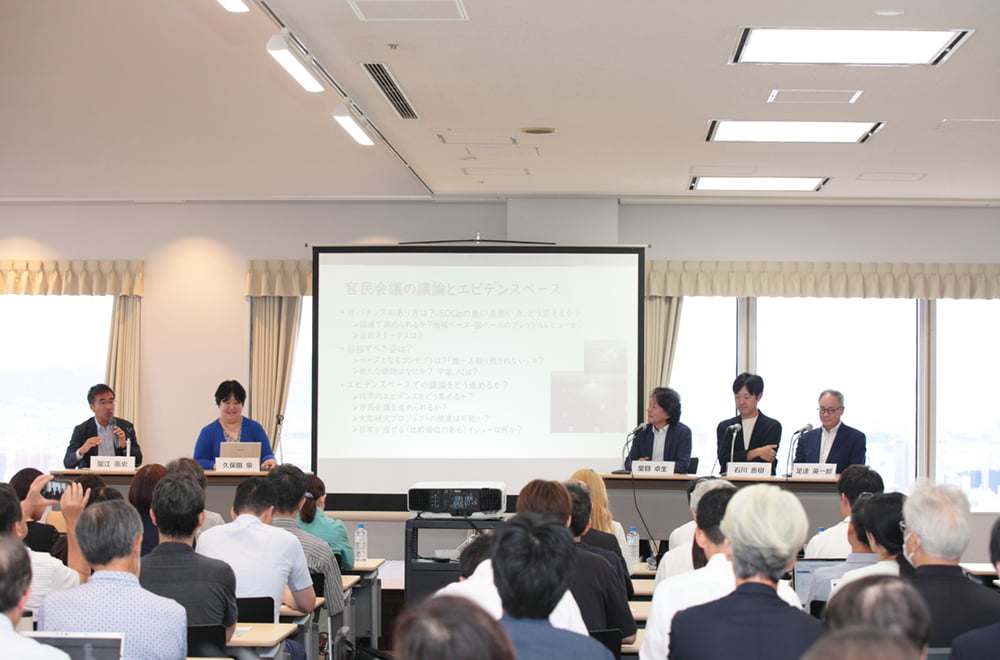
Ahead of the discussions on Beyond SDGs beginning in 2027, what contribution can Japan make? In this panel discussion, multifaceted discussions were held on topics ranging from changes in legal binding forces as seen in the International Court of Justice (ICJ) advisory opinion on climate change, to a new vision for society centered on “a society where life shines,” global data strategies and well-being learned from private foundation initiatives, and the challenges facing the financial sector. The participating experts presented two key axes: an evidence-based scientific approach and a vision that resonates with people’s hearts. By aligning public opinion, data, and concrete examples, a clear path toward achieving true societal transformation emerged.
Panelists
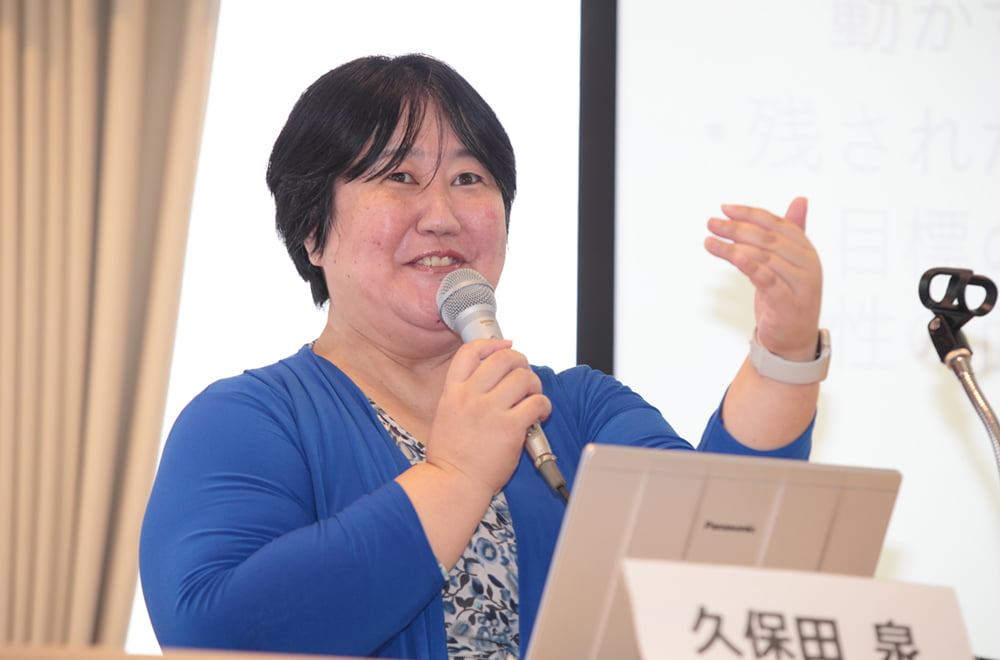
Izumi Kubota (Senior Researcher, Social Systems Division, National Institute for Environmental Studies)
Takuo Dome (Advisor to the President, Osaka University / Specially Appointed Professor, Social Solution Initiative)
Yoshiki Ishikawa (Representative Director, Well-being for Planet Earth)
Eiichiro Adachi (Fellow, The Japan Research Institute, Limited)
Moderator
Norichika Kanie (Professor, Graduate School of Media and Governance, Keio University / Chairperson, Public Private Forum on Beyond SDGs)
A First Step in Discussions Pursued from a Long-Term Perspective
- Kanie
In discussing this theme, it is extremely important to proceed on an evidence-based approach. When the SDGs were formulated, diplomats spent a year and a half learning the evidence, and actual negotiations took place during the final six months. Accumulating evidence is that crucial.
In this panel discussion, we would like to broaden our perspective to 2075 and 2100, while discussing 2050 as a waypoint along that path.
First, I would like to ask Ms. Kubota about the recent advisory opinion on climate change issued by the International Court of Justice, and then listen to everyone else in turn.

Entering an Era Where Law and Science Intersect
- Kubota
In the advisory opinion on climate change published by the International Court of Justice on July 23, the most important point is its statement that, based on the latest scientific findings, using all available means to achieve targets is a state obligation under international law.
Scientists also need to play a role in connecting policy and science. The achievement of the SDGs lies in having provided a powerful force to mobilize many actors by presenting goals that the international community should share; however, because target achievement relies on voluntary efforts by each country, there are challenges regarding effectiveness.
A hint to overcoming this challenge can be found in the advisory opinion of the International Court of Justice. An article by European researchers was titled “The Great Reset,” reflecting how deeply significant this advisory opinion is.
I feel that we have entered an era where both the validity of setting targets (what we aim for) and the validity of how we achieve them are legally questioned based on scientific evidence.
To enhance effectiveness, we must aim for international agreements backed by scientific findings. Going forward, science will provide a yardstick to evaluate whether the processes by which national governments and companies fulfill their obligations are scientifically valid, and it will be important for civil society to use that yardstick to monitor government actions.
What is also important is that it states that the right to enjoy a clean, healthy, and sustainable environment is a human right and a prerequisite for all human rights. Since Japan is among the minority of countries that do not specify environmental rights in either law or the Constitution, this has a major impact on Japan.
- Kanie
The SDGs and the Paris Agreement are often referred to as twin agreements, so it is significant that this advisory opinion emerged under the Paris Agreement. A similar direction might emerge for the SDGs in the future as well.
Designing Society Starting from Mutual Aid and Empathy
- Dome
As a result of studying the history of economics for 30 years, I thought about what kind of society we have built over the past 200 to 300 years of modern history. In the center of society are “capable people” who contribute to the production of goods, services, and knowledge. Those who cannot contribute (or are deemed unable to)—such as children, the elderly, persons with disabilities, patients with intractable diseases, and foreign nationals—are pushed to the periphery of society. Even when we speak of inclusion, if it operates within a framework where the vulnerable join the ranks of “capable people,” the centrality of “capable people” remains completely unchanged; it is simply a structure where the vulnerable are empowered to become like “capable people.”
In the new era, in Beyond, a mindset shift is required. The society we should aim for is one that places life requiring help at the center of our awareness and institutions. This includes not only humans, but non-human living creatures and the planet itself.
Those who happen to possess the means to help are embraced through empathy for the lives requiring help on the periphery of society; when they try to help, a relationship of mutual aid emerges where they realize they are ultimately being helped themselves. There are countless voices of caregivers saying they are actually being supported by the person they are caring for. A person who was on the giving side yesterday may suddenly require help today, or someone who was being helped may in turn move to the helping side. Survivors of the Great Hanshin-Awaji Earthquake went to volunteer during the Great East Japan Earthquake because they understood the feelings of those needing help better than anyone. Stories of mutual aid like these abound at the front lines of social challenges, and by focusing on what is already there, we can build a society of mutual aid inspired by them.
That global challenge is precisely the SDGs. Leaving no one behind means considering those left behind as central. I began activities for this purpose in 2015.
The Expo also speaks of “Designing Future Society for Our Lives,” but it is crucial to first search for where lives that are not shining, or lives whose radiance is being impeded, are located.
Two years ago, Osaka University and the Kansai business community jointly launched the “Inochi Forum.” Its core activity is listening to the voices of life. If we act without listening, we end up leaving people behind. Even if we conduct surveys, do people write their true feelings? And what about the voices of those who cannot write their true feelings? That is the most difficult, yet most vital, aspect.
Based on those voices, people who can take action gather to discuss, act, and record their thoughts in words. To hand down this mission across 1,000 years to the next generation, we have held about 50 actions and workshops across 12 themes. There are always things to do, and there are always people who will do them. We receive those action plans and build our declaration on that foundation.
The beginning of the “Inochi Declaration” is as follows:This irreplaceable life bestowed upon us
Is fragile, vulnerable, and changes with time
Every life conceals a radiance within
And all lives are connected
Each and every life
Let us protect, nurture, and pass on
Let us unleash the hidden radiance
Let us know the meaning of being alive
Let us return to the source of lifeWe will announce this declaration on October 11 at the Expo’s Festival Stage. I believe the method of creation—how we build it up from the bottom up to make the SDGs feel like a personal matter right from the start—is also essential.

Challenges and Possibilities of Well-Being Made Visible Through Data
- Ishikawa
Back in 2000 during the Kyushu-Okinawa Summit, I think Japanese adults were truly impressive. Prime Minister Obuchi positioned healthcare as a key global issue for the first time at a G7 summit, addressing HIV/AIDS, tuberculosis, and malaria as life-critical top-priority themes. As a result, Japan led in creating social value, which ultimately transformed financial flows as well.
In Goal 8 of the SDGs, “Decent Work and Economic Growth,” I consider Mastercard’s contribution to be significant. They positioned “financial inclusion”—meaning every individual having an account with a financial institution—as a global KPI. For people without an account, life is literally a daily struggle from hand to mouth. For instance, farmers may receive income during harvest season but quickly exhaust it, needing loans for the next planting. That adversely affects family health and children’s education as well. That is precisely why account ownership rates became a breakthrough indicator for “decent work” and “economic growth.”
It was the Mastercard Foundation that led this KPI setting. No matter how noble a vision or law may be, it amounts to nothing without global data. Supported by the foundation, the World Bank and Gallup conducted research showing that the account ownership rate, which was 51% in 2011, rose to 76% by 2021. In the Republic of Malawi in southeastern Africa, it grew significantly from 16% to 42%. Through such data, it became concrete and visible who was in trouble and where assistance was needed.
JICA’s agricultural support also expanded beyond technology to encourage account opening. This established mechanisms for development assistance funds and financial market capital to flow in, strengthening Mastercard’s presence in developing nations relative to VISA on the ground.
And now, the discussion is moving to the next stage. “Financial Well-being” has become a theme at the G20. Looking toward the Beyond SDGs era, which international organizations we partner with and what global data we measure will be critically important. It will be too late if we do not act immediately. Full-scale discussions on Beyond SDGs will begin at the UN starting in 2027, but whether the public and private sectors can work together to establish the necessary data before then will serve as Japan’s concrete contribution.
Our Well-being for Planet Earth Foundation is working with international organizations toward acquiring global data across various fields, such as financial well-being, food and well-being, and health and well-being.

A Virtuous Cycle of Sustainability Created by Finance and Citizens
- Adachi
Ever since launching an eco-fund in 1999, I have been involved in ESG investment for 25 years. However, the world of finance is fundamentally about “money,” where whether or not a profit was made ultimately becomes the criterion for evaluation. Clear evidence showing that companies dedicated to sustainability are fairly valued and that this leads to returns for investors has still not been sufficiently demonstrated. I have spent a quarter of a century challenging how to incorporate elements other than profit into finance, yet it remains a world where those who make short-term profits are highly valued. The financial sector is not straightforward either. Regarding SDGs and ESG, people are divided between those who ask, “Do we really have time for this?” and those who say, “No, this is vital.”
What is important is a positive cycle where consumer actions like buying green steel over brown steel, and youth actions like choosing not to work for problematic companies, occur simultaneously, while finance observes this on an evidence basis and invests accordingly. What I feel from 25 years of work is that unless both wheels turn together, finance trying hard on its own is not enough. Civil society must generate greater impact, and finance must attach capital to it. Building up that movement is essential.
- Kanie
What should we do to make both wheels turn?
- Adachi
One way is to involve more rare business leaders like Paul Polman. Mr. Polman spoke continuously about sustainability while serving as CEO of Unilever for 10 years, going so far as to state that “management is a means to that end.” I hear he originally aspired to enter the clergy, and perhaps that religious background influenced him.
Diverse actors exist in society. In Japan, we tend to stay confined within government, academia, and industry, but there should be much broader possibilities. And what is important is creating an atmosphere where anyone can speak up. Right now, there is an air of snuffing out differing opinions, but discussions cannot deepen that way. People voicing diverse views, participating in what they feel is good, and building momentum as a movement—we need to create such an encouraging atmosphere.

Collaborating with International Organizations Connected by Evidence
- Dome
Let me supplement on evidence. In my organization, we issue rankings by weighting public data on what Prime Market-listed Japanese companies are doing regarding the environment and human rights.
We keep saying “evidence, evidence,” but when shopping, we judge solely by price and content, don’t we? We consume products without considering information such as which factory produced them, whether child labor was used, what materials were used, or what happens after disposal. We need to make such information easily understandable. Even if understanding it doesn’t guarantee a purchase, by raising awareness further, it is possible to create a market where companies striving to support life, nature, and human beings through good ideas can properly survive. I believe expanding that globally is the next stage.
- Ishikawa
I strongly feel that unless we involve international organizations from the outset, it is meaningless. If we act by ourselves and make proposals after the fact, it is difficult to get international organizations to recognize them. Data collection is the same: it is crucial to consult with specific international organizations from the beginning and jointly consider “what data should be collected and how.” Where Mastercard and Unilever excel is that they partnered with international organizations right from the start. Japan has a track record of contributing funds to international organizations and is historically trusted. That is precisely why I believe there is fertile ground for proposals from Japan to be accepted.
Moving Forward with Diverse Voices
- Kanie
Going forward, if we can advance this discussion together with various people while receiving diverse advice, we will be able to foster even more fruitful discussions. As a platform for everyone to initiate dialogue, I hope we can continue to bring forth a wide variety of ideas at the Public Private Forum.

Photo: Yasuhiro Fujii
Coverage: Impress Sustainable Lab “SDGs White Paper” Editorial Department
Graphic Recording: Sayaka Taniko (GREAT WORKS)
Click here for the Public Private Forum on Beyond SDGs Kick-off Forum: Report 【Opening Remarks and Input Talk】
Click here for the Public Private Forum on Beyond SDGs Kick-off Forum: Report 【Panel Discussion ①】