
Public Private Forum on Beyond SDGs Kick-off Forum: Report 【Opening Remarks and Input Talk】
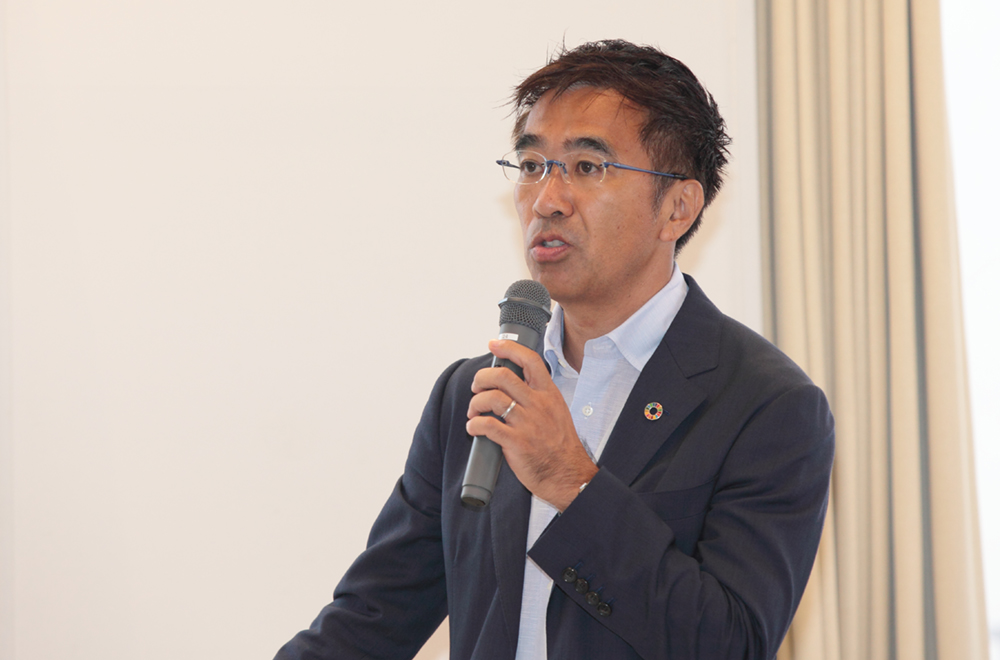
Ahead of the United Nations beginning the formulation of the next goals for the SDGs in 2027, the “Public Private Forum on Beyond SDGs” was launched with the participation of diverse entities—including government, business, civil society, and academic institutions—aiming to synthesize recommendations from Japan and Asia. On September 4, 2025, a kick-off forum was held. At the beginning of the forum, Sumi Nishizaki, Deputy Director-General of the International Cooperation Bureau at the Ministry of Foreign Affairs, spoke about its significance, followed by Norichika Kanie, Chairperson of the Public Private Forum on Beyond SDGs, who presented the policy for moving forward. Through two sessions, participants forged a shared understanding to lead the construction of a new international framework from Japan and Asia toward the realization of a “society where no one is left behind.”
Opening Remarks
Sumi Nishizaki (Deputy Director-General, International Cooperation Bureau, Ministry of Foreign Affairs)
Today’s Public Private Forum on Beyond SDGs Kick-off Forum is an important platform to constructively discuss the current state and challenges surrounding the SDGs from diverse perspectives, contributing to the creation of the next goals that everyone around the world can participate in, as well as the mechanisms to achieve them.
In this year, which marks the 10th anniversary of the adoption of the SDGs at the UN, and when Japan submitted its progress report on the SDGs to the UN for the first time in four years, it is highly significant to launch a forum themed on Beyond SDGs, namely the international sustainability framework beyond 2030. Additionally, at Expo 2025 Osaka, Kansai, “SDGs + Beyond” is positioned as a key theme.
The government is reflecting efforts to achieve the SDGs in domestic and foreign policies, such as in renewable energy and climate change measures, and is pushing forward as a united public and private sector to realize them. Japan will continue to consistently and actively engage domestically and internationally toward achieving the SDGs, and will advance initiatives from a long-term perspective to play a leading role in international discussions and rule-making beyond 2030.
To realize a society where no one is left behind, it is important that everyone contributes. Diverse stakeholders working together to solve social issues with flexible ideas and ingenuity, turning them into engines of growth, will pave the way toward achieving the SDGs and, ultimately, a sustainable society beyond 2030.
This Public Private Forum on Beyond SDGs Kick-off Forum is a platform for intellectual exchange where diverse stakeholders—including government, business, civil society, experts, local governments, and academia—collaborate and share knowledge. For better discussions, it is essential to bring together diverse data and evidence from a wide range of fields, and the role you all play is extremely important. I hope that discussions based on your respective knowledge and data, and the concrete initiatives born from here, will lead to the promotion of the SDGs domestically and internationally, and furthermore to the realization of a richer future beyond 2030.
I pray that the circle of SDG promotion will expand even further through everyone’s active contributions, and the government will also continue to accelerate efforts toward achieving the SDGs in collaboration with all of you.

Input Talk: “Toward ‘Beyond SDGs’: Japan’s New Initiatives Toward Goal-Setting Beyond 2030”
Norichika Kanie (Professor, Graduate School of Media and Governance, Keio University / Chairperson, Public Private Forum on Beyond SDGs)
At this Public Private Forum on Beyond SDGs Kick-off Forum, we are hosting a multi-stakeholder forum to discuss goals beyond 2030. An initiative of this scale is the first of its kind in the world.
It has already been decided that the United Nations will discuss the next goals for the SDGs in 2027, and countries around the world are beginning to tackle this issue. However, there is no country yet that is discussing it in a multi-stakeholder manner. By incorporating a uniquely Japanese perspective here, we hope to lead the UN process, Japan’s domestic process, and the Asian process.

New Participation Model Demonstrated by Japan’s VNR
This year, Japan presented its third Voluntary National Review (VNR) at the United Nations. What received the greatest response was the fact that we were able to present a stakeholder participation model. Compared to VNRs from other countries, Japan’s review significantly features independent reviews by stakeholders, and even includes critical opinions on policies.
This process itself was conducted democratically, from the government’s roundtable to the stakeholder meeting in March, and further to public comments seeking a broad range of opinions. Such a process has received high international acclaim, and we will connect this model to the activities of the post-2030 agenda.
Significance of the Project Looking Ahead Beyond 2030
At the UN SDG Summit to be held in September 2027, global discussions are scheduled to begin. While there are conflicts in the world and headwinds against sustainability can be heard, it is indispensable to think about the world beyond 2030. Even if it is not in the form of the United Nations, advancing this discussion at all regional and domestic levels is important in considering the direction of action, economy, society, and environment toward 2050 and 2100.
In particular, Japan is located in Asia, and Asian voices were not reflected so prominently in the current SDGs. However, because the role that Asia will play in the future will become very large, it is important to think about what the future should look like together with our peers in Asia.
Also, sustainability in island nations is increasing in importance. There are challenges unique to island nations, where the future cannot be seen unless society is operated cyclically within a limited space. Japan itself is an island nation, and collaboration with other islands is also an important element in this forum.
Building Domestic Structures and International Collaboration
Domestically, this Public Private Forum on Beyond SDGs, which evolved from the Japan SDGs Action Promotion Council, will begin its operations. At the same time, we will advance collaboration with global, Asian, and island nations. Evidence-based discussion is important, and we plan to collaborate with international networks of researchers.
As advisors, we have appointed Csaba Kőrösi, former UN Ambassador of Hungary who served as Co-Chair of the Open Working Group on SDGs and created the framework of the 169 targets and 17 goals, and Zakri Abdul Hamid from Malaysia, and we will advance internationally viable dialogues.
Step-by-Step Rollout Toward Proposals in 2027
With this forum as a starting point, while receiving input from everyone, we will gather opinions through our website and various mechanisms, and enter the workshop phase. We will aggregate ways of thinking by group, advance discussions on possible goals for the next world, and aim to present proposals in 2027. Beyond 2027, we will delve deeper into the proposals and reflect them internationally and domestically.
For group divisions, we will utilize the six entry points of the Global Sustainable Development Report (GSDR) published by the UN in 2023 (Human well-being and capabilities; Sustainable and just economies; Sustainable food systems and healthy nutrition; Decarbonization with universal access to energy; Urban and peri-urban development; and Global environmental commons). This framework is appropriately distributed for considering the relevance of various issues, and Jeffrey Sachs of Columbia University has published a similar proposal in a scientific journal.
Challenges and the Need for Collaboration Seen from Global Discussions
We held a discussion at a side event of the High-Level Political Forum (HLPF) in July. There, various opinions emerged, such as the importance of collaboration with developing countries rather than being led by developed nations, the necessity of discussions involving the UN, and focusing on the parts of the SDGs that have been achieved. What was particularly important was the point that this process itself is indispensable for moving to the next goals.
How to Address Climate Change and Poverty
This year’s abnormal heat is just the beginning, and scientifically, a further increase in the global average temperature is predicted. As a response to this situation, while there is a need to reduce energy use, a cheap and easily accessible energy supply is also necessary to ensure energy access for the poor. Science shows that the remaining measures are very narrow just for the single challenge of climate change and poverty.
To walk this narrow path, the wisdom of various stakeholders, including the younger generation, is required. Through science-based discussions, we want to generate various ideas and set future goals.
Basic Policy of This Forum
In this forum, we plan to advance evidence-based discussions. We will think about the state of humanity and the Earth while unravelling the latest scientific information in an easy-to-understand manner. Also, we will strive for positive discussions rather than denial, and hope to collect diverse ways of thinking while acknowledging each other.
We will comprehensively collect the outcomes from various stakeholders and discussion venues other than this one, including the Expo, and advance future processes while reflecting the results of the discussions.

Photo: Yasuhiro Fujii
Coverage: Impress Sustainable Lab “SDGs White Paper” Editorial Department
Graphic Recording: Sayaka Taniko (GREAT WORKS)
Click here for the Public Private Forum on Beyond SDGs Kick-off Forum: Report 【Panel Discussion ①】
Click here for the Public Private Forum on Beyond SDGs Kick-off Forum: Report 【Panel Discussion ②】